

How to Choose Durable Home Organizers: A 2026 Guide
Last Updated: October 24, 2026
Quick Summary
Durable home organizers are chosen by matching material to room conditions, checking construction quality and hardware integrity, and assessing your actual storage needs before buying. Select from plastic for visibility and moisture resistance, stainless steel for strength and longevity, or wood for aesthetic appeal, then verify load capacity, stability, and repairability.
- Clear PET plastic organizers need at least 3mm wall thickness and UV-resistant formulation to resist brittleness in sunlight.
- Stainless steel is the premium choice for moisture-prone areas because it won't rust even if scratched, while powder-coated metal is a solid middle ground.
- MDF bathroom cabinet towers can hold up to 22 pounds per shelf, suitable for towels and toiletries but not heavy items.
- Inspect welds on metal organizers for uniformity and cleanliness, and confirm plastic corners are reinforced rather than simple butt joints.
- Stay at roughly 70-80% of rated capacity to extend service life, and anchor tall units to walls to prevent tipping injuries.
Table of Contents
- What Makes Home Organizers Durable: The Foundation
- Best Materials for Storage Containers and Their Trade-Offs
- How to Measure for Storage Bins and Assess Your Space
- Evaluating Durable Storage Bins: What to Check Before Buying
- Storage Organizer Buying Tips: Room-by-Room Decisions
- Decluttering First: Why Sorting Before Buying Matters
- Long-Term Care and Maintenance for Lasting Organizers
- Frequently Asked Questions
What Makes Home Organizers Durable: The Foundation
Choosing durable home organizers starts with three factors: material selection, construction quality, and honest assessment of what you're storing.
Durability is concrete: weight capacity, seam stitching, hardware corrosion, and whether the material cracks under stress or UV exposure.
At Velo Shop X, we've curated home organizers that prioritize lasting construction, because constantly replacing storage defeats the purpose of organizing.
Best Materials for Storage Containers and Their Trade-Offs
No single material is "best", the right choice depends on your room, what you're storing, and how much wear the organizer will face.
Plastic and PET: Lightweight and Stackable
Clear PET (polyethylene terephthalate) organizers are transparent, stack efficiently to save vertical space, and resist moisture, making them safe for bathrooms and kitchens.
The trade-off: plastic becomes brittle over time, especially in sunlight or extreme temperatures (Photodegradation and photostabilization of polymers, especially polystyrene: review).
The 2026 closet and storage trends report highlights that consumers increasingly value durability alongside functionality.
Metal and Stainless Steel: Strength and Longevity
Stainless steel and powder-coated metal shelving deliver strength plastic cannot match: heavier loads without bending, moisture resistance, and no brittleness with age.
The trade-off: metal costs more upfront and can rust if the coating is damaged or in extremely humid environments.
Stainless steel is the premium choice, since it won't rust even if scratched; carbon steel with a quality powder coat is a solid middle ground.
Wood and MDF: Style with Structural Limits
Wood and medium-density fiberboard (MDF) bring aesthetic appeal plastic and metal don't.
The trade-off: wood and MDF swell when wet and can warp permanently, are heavier than plastic, and don't support loads as heavy as metal.
Check weight capacity carefully: an MDF bathroom cabinet tower can hold up to 22 pounds per shelf, suitable for towels and toiletries but not heavy items.
Each material offers distinct advantages and trade-offs depending on your room conditions and storage needs.
| Material | Best For | Key Trade-Off |
|---|---|---|
| Clear PET plastic | Bathrooms, kitchens, visibility | Becomes brittle in sunlight; needs 3mm+ thickness |
| Stainless steel | Strength, moisture, longevity | Higher upfront cost; premium choice |
| Powder-coated metal | Strength, middle-ground cost | Rusts if coating is damaged |
| Wood and MDF | Aesthetic appeal, style | Swells when wet; max 22 lbs per shelf |
| UV-stabilized plastic | Near windows, UV exposure | Standard plastic cracks over time |
How to Measure for Storage Bins and Assess Your Space
Most buying mistakes happen before checkout: people measure the shelf but not the items, or ignore moisture, weight, sunlight, and cleaning needs. This needs-first process helps you buy organizers that fit both your space and your belongings.
Step 1: Measure the Space in Three Dimensions
Measure every space where an organizer will go, and record the numbers:
- Available width: the horizontal space the organizer will occupy.
- Available depth: how far back the organizer can extend.
- Available height: the vertical clearance above the organizer, including any door swing or shelf above.
For drawer organizers, measure the interior dimensions, not the outer frame, and note drawer depth, shallow drawers reject many standard dividers. For pull-out bins and under-sink organizers, measure door clearance and confirm doors swing fully open without hitting the organizer.
Step 2: Inventory What You're Actually Storing
This is the step most people skip. Before buying bins, totes, or baskets, pull everything out of the space.
- Group similar items together.
- Measure the tallest item, the widest item, and the bulkiest item in each group.
- Count how many of each category you have.
You now have a real inventory rather than a guess. A modular set such as the 25Pcs Clear Plastic Drawer Organizer set, which comes in four sizes (S, M, L, XL), lets you combine compartments to match that inventory, cosmetics, utensils, office supplies, or jewelry, instead of forcing items into a one-size-fits-all solution.
Step 3: Match Material to Room Conditions
Material choice should follow the conditions in the room, not just appearance. Use this comparison as a starting point:
- Kitchen and bathroom (moisture, grease, frequent cleaning): Metal, stainless steel, and sealed plastic are safest. Raw wood and MDF swell and warp in humid conditions; clear PET is easy to wipe down and lets you see contents.
- Laundry room and basement (humidity swings): Stainless steel or powder-coated metal with intact coating; avoid unfinished wood and low-grade plastic that becomes brittle.
- Closet and bedroom (dry, weight-bearing): Wood and MDF are acceptable if shelves are braced and loads are moderate; metal dividers are sturdier for heavy stacks of folded clothing.
Step 4: Check Load and Clearance Before You Commit
- Divide your total stored weight by the number of shelves or drawers, and compare that to the manufacturer's per-shelf and per-drawer ratings.
- Confirm the footprint fits your measured width and depth with a small margin for door swing and hand access.
- For tall units, confirm wall-anchoring hardware is included or available.
Step 5: Decide Based on Long-Term Value, Not Just Upfront Price
Compare organizers on expected lifespan, replacement frequency, warranty coverage, and whether parts can be repaired or replaced. A slightly pricier metal or sealed-wood organizer that lasts a decade usually costs less over time than a cheap plastic bin replaced every year or two.
Evaluating Durable Storage Bins: What to Check Before Buying
Once you know your space and what you're storing, evaluate organizers with a repeatable inspection routine rather than a gut feeling. Use the five checks below in order: construction, hardware, load and stability, fabric details, and repairability.
1. Material and Construction Check
Identify the primary material and how the bin is assembled, because joinery is usually where failure begins.
- Plastic and PET: Look for wall thickness of roughly 3 mm or more on load-bearing panels. Squeeze the sides, a durable bin flexes slightly and returns to shape; a brittle one creaks or shows stress whitening at the corners. Check that corners are reinforced (double-wall or molded gussets) rather than simple butt joints, and confirm UV-stabilized labeling if it will sit near a window.
- Metal: Run a finger along welds, they should be uniform, continuous, and free of spatter or pinholes. Powder coat should be even with no thin spots at edges, since bare steel is where rust starts. Stainless steel resists corrosion even when scratched; powder-coated carbon steel depends entirely on coating integrity.
- Wood and MDF: Check that shelves are supported at multiple points and that the cabinet has internal bracing (a back panel, crossbars, or a center support). Sealed or laminated surfaces resist moisture far better than raw MDF edges. Dowels plus screws and glue outperform staples alone.
Quick field test: press down firmly on the center of a shelf or the base of a bin. Sagging or creaking under hand pressure is a warning sign for loaded use.
Kitchen Sink Organizer Carbon Steel Storage Rack →
2. Hardware and Fastener Check
Hardware fails before structure does, so inspect it directly.
- Handles: Metal handles should be welded or bolted through the panel, not riveted to a thin face. Plastic handles should be molded as part of the structure, not attached afterward.
- Drawer slides: Full-extension slides distribute load more evenly and last longer than partial-extension slides. Pull the drawer fully out and push it back several times, it should glide without binding, wobble, or a gritty feel.
- Hinges and catches: Hinges should feel solid with no side-to-side play. Magnetic catches hold up better than friction catches over repeated use.
3. Load Capacity, Stability, and Safety
Weight ratings are only useful if you interpret them correctly.
- Read ratings per shelf and per drawer separately, they are often different. A shelf rated for 22 pounds and a drawer rated for 11 pounds are common on the same unit. Divide your total stored weight by the number of shelves or drawers to see whether the unit can carry your load with margin.
- Leave headroom. Loading consistently to the stated maximum accelerates wear on joints and slides. Staying at roughly 70-80% of rated capacity extends service life noticeably.
- Check tipping risk. Tall, narrow shelving and heavily loaded bins should be anchored to the wall, especially in homes with children or pets. Confirm the unit includes or accepts an anti-tip strap or bracket.
4. Fabric-Specific Details: Zippers, Seams, and Handles
For soft bins and storage bags, closures and seams are the weak points.
- Run the zipper slowly, it should move smoothly without binding or catching. Metal zippers generally outlast plastic ones under repeated use.
- Check that seams are double-stitched and reinforced at corners and stress points.
- Confirm handles are stitched through multiple layers with reinforcement at the attachment area.
5. Repairability and End-of-Life
Durability is also about whether a product can be kept in service.
- Replaceable parts: Drawer slides, handles, feet, and casters that can be ordered and swapped extend lifespan far more than a marginally stronger frame.
- Warranty coverage: A stated warranty is a signal of confidence, but read what it covers, frame only versus hardware versus fabric.
- Repairability: Metal and wood organizers can often be re-tightened, re-glued, or re-finished. Many plastic bins cannot be repaired once cracked, shortening their effective life even if the upfront price is lower.
Storage Organizer Buying Tips: Room-by-Room Decisions
An organizer that works perfectly in a bedroom closet might fail in a humid bathroom.
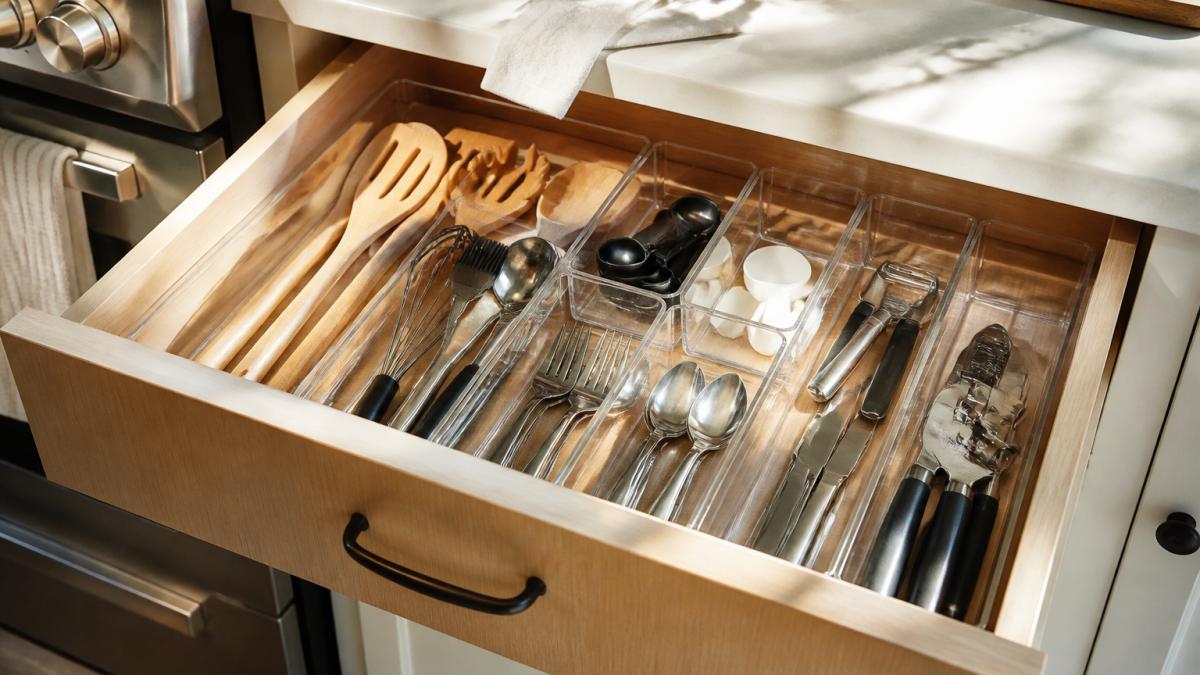
Kitchen Organization: Sinks, Drawers, and Cutlery
Kitchens are wet, greasy, and high-traffic. Organizers must resist moisture and handle frequent use.
Under-sink organizers face constant moisture and temperature swings. The Kitchen Sink Organizer Carbon Steel Storage Rack handles up to 75 pounds per linear foot, supporting heavy cookware and cleaning supplies while resisting rust in a humid environment.
Drawer organizers for cutlery and utensils need to be easy to clean and durable enough for daily use. Clear plastic dividers let you see what's where, and non-slip feet keep the organizer from sliding.
Closets and Clothing: Shelf Dividers and Pull-Out Bins
Closets are dry but crowded. Organizers must support weight without tipping and provide easy access.
Shelf dividers prevent stacks of folded clothes from toppling over, and metal dividers are sturdier than plastic for heavy loads.
Weight distribution matters in closets. Don't load all weight onto one shelf, spread it across multiple shelves to prevent sagging and tipping.
Entryways and Shoes: Open Racks and Over-the-Door Options
Entryways see high traffic and seasonal temperature changes, so shoe organizers need to be stable and easy to use.
Open shoe racks are more durable than enclosed bins because they don't trap moisture. Metal racks with non-slip feet won't tip when you're pulling on shoes. Over-the-door organizers must be securely mounted, a falling organizer full of shoes is a safety hazard.
Decluttering First: Why Sorting Before Buying Matters
Here's the mistake most people make: they buy organizers, then try to fit their stuff into them.
Pull everything out of the space. Create piles: keep, donate, discard. Items you haven't touched in a year probably don't belong in prime storage space.
This process also reveals whether you have a storage problem or a consumption problem.
Long-Term Care and Maintenance for Lasting Organizers
Buying a durable organizer is half the battle. Maintaining it properly extends its life significantly.
Clean organizers regularly. Dust plastic and metal surfaces with a damp cloth.
Check hardware periodically. Tighten loose bolts and screws.
Avoid overloading.
Protect from extreme conditions.
Organizing your home is an investment in daily convenience and space efficiency.
Frequently Asked Questions
How can you tell if a storage bin is durable?
Check the weight capacity first, a durable storage bin should clearly state its load limits. Inspect the materials: PET plastic, stainless steel, and reinforced MDF are stronger than thin plastics. Look for reinforced seams, quality zippers that move smoothly, and handles that don't flex when you apply pressure. Non-slip feet prevent sliding, and stackable designs without warping under weight indicate good construction. Read reviews mentioning longevity over time, not just first impressions.
Which materials are best for long-lasting home organizers?
Stainless steel and carbon steel offer the highest durability and resist rust and corrosion, ideal for kitchens and damp areas. PET plastic (like in high-quality drawer organizer sets) is lightweight, stackable, and resists cracking if reinforced with non-slip features. MDF boards work well for cabinets and shelving in dry rooms but have lower weight capacity (typically 10-22 pounds per shelf) than metal. Match the material to your room's moisture level and the weight you're storing.
Why should I sort and declutter before buying storage organizers?
Buying bins before you know what you're storing leads to wasted money and poor fit. Sort first to understand the volume, shape, and weight of your items, then choose organizers that actually match your needs. This prevents buying too many small containers for large items, or oversized options that waste space. You'll also spot items to donate or discard, reducing clutter immediately and making your final storage system more practical and cost-effective.
What weight capacity should a shelf or storage organizer hold?
For everyday household items, check the manufacturer's specs before loading, exceeding capacity causes sagging, warping, and potential failure. Distribute weight evenly across the shelf to avoid stress on corners and edges, and leave a small margin below the maximum to ensure long-term durability.
