

How to Remove Hard Water Stains From Glass Vases
Last Updated: November 10, 2026
Quick Summary
To learn how to remove hard water stains from glass vases, mix one part white vinegar with one part warm water, fill the vase to cover the stained area, and soak for 30 minutes to a few hours. Add a spoonful of uncooked rice or coarse salt, swirl gently, then rinse with warm water.
- Wet the spot first: if cloudiness vanishes while wet, it is mineral film you can clean.
- For light film, use 1 part vinegar to 2 parts warm water and soak 20-30 minutes.
- The rice method uses two tablespoons of uncooked long-grain white rice, one cup warm water and half a cup vinegar.
- Never force a brush into a bud vase, since a stuck brush plus twisting cracks glass.
- Rinse vases after each use and dry with a microfiber cloth instead of air drying.
Table of Contents
- How to Remove Hard Water Stains From Glass Vases: The Short Version
- Vinegar for Hard Water Stains on Glass: Ratios, Soak Times and Repeat Treatments
- How to Clean a Cloudy Vase With Uncooked Rice, Salt and Ice
- Cleaning a Narrow-Neck Glass Vase Without Breaking It
- Matching the Method to Stain Severity and Vase Shape
- Preventing Water Spots on Glass Vases
- Which Glass Is Safe to Clean at Home, and Which Is Not
- Stock Your Cleaning Shelf With Velo Shop X
- Frequently Asked Questions
How to Remove Hard Water Stains From Glass Vases: The Short Version
Learning how to remove hard water stains from glass vases starts with a warm white vinegar soak, followed by a gentle abrasive swirl. This is one of the most common cleaning questions for first-time renters, and the fix is usually already in the kitchen.
Here is the short version:
- Mix one part white vinegar with one part warm water.
- Fill the vase so the stained area is fully covered.
- Let it sit for 30 minutes to a few hours, depending on how stubborn the stains are.
- Add a spoonful of uncooked rice or coarse salt.
- Swirl and shake gently, then rinse with warm water.
That sequence handles most cloudy mineral deposits on glassware. The rest of this guide covers ratios, soak times, and the cases where vinegar will not help.
Mineral film or etched glass? Test before you treat
Not every white mark on a glass vase is a stain. Some of it is permanent damage, and no amount of vinegar will fix it.
Mineral deposits sit on top of the glass.
Try this quick test. Wet your fingertip and rub the spot. If the cloudiness disappears while wet and returns when dry, it is mineral film and you can clean it. If the surface feels rough or the haze stays put, the glass is etched.
Watch out: scrubbing etched glass with abrasives makes it worse, not better. Once glass is etched, only professional polishing can restore it.
Vinegar for Hard Water Stains on Glass: Ratios, Soak Times and Repeat Treatments
White vinegar is the workhorse here because its acid dissolves the calcium and magnesium that make up hard-water stains. The U.S. Geological Survey's guide to hard water explains that these dissolved minerals are what leave deposits behind when water evaporates.
Use these ratios:
| Stain Level | Vinegar to Water | Soak Time | Repeat Treatments |
|---|---|---|---|
| Light film | 1 part vinegar : 2 parts warm water | 20-30 minutes | Usually none |
| Moderate spots | 1 part vinegar : 1 part warm water | 1-2 hours | 1-2 |
| Heavy buildup | Full-strength white vinegar | 4-8 hours or overnight | 2-3 |
Warm water matters. It speeds up the reaction, so a warm solution works faster than a cold one. Never use boiling water, though, because sudden heat can crack thin glass.
For tall vases, fill to the top so the solution covers every stained band. For repeat treatments, pour out the old mix, rinse, and start fresh. Reusing a dirty solution just redeposits the minerals you removed.
When to add baking soda, dish soap or salt
Vinegar alone handles most jobs, but a few additions help in specific cases:
- Baking soda: add a spoonful for extra lifting power on stubborn stains. It fizzes on contact with vinegar, which helps loosen deposits.
- Dish soap: a few drops cut through oily residue from flowers or tap water film.
- Salt: coarse salt adds mild abrasive action for scrubbing the glass surface.
A ready-made option works well if you would rather not mix anything: our All Purpose Rust Remover Spray Fast Acting is built for exactly this kind of mineral and rust film.

How to Clean a Cloudy Vase With Uncooked Rice, Salt and Ice
The rice method is the best trick for a cloudy vase with a narrow opening, because the grains reach places a brush cannot.
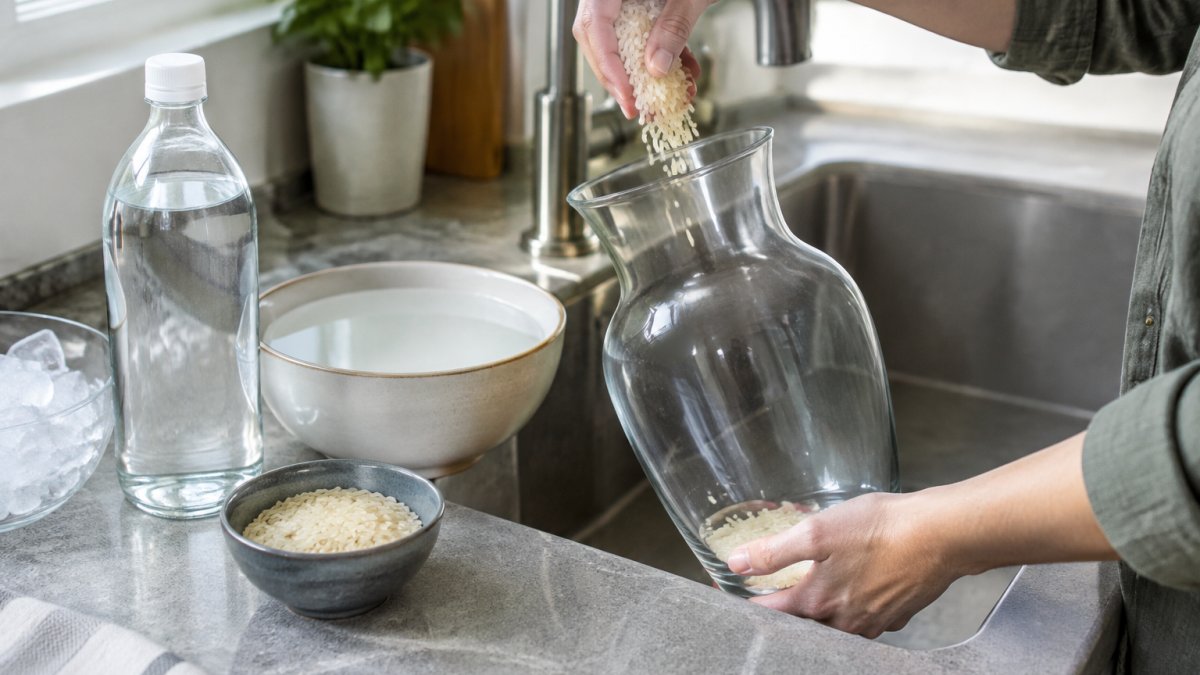
Here is the full method with reproducible amounts:
- Add two tablespoons of uncooked long-grain white rice to the empty vase. Long-grain is preferable to short-grain because the grains are firmer and less likely to break down into a starchy paste.
- Pour in one cup of warm water and half a cup of white vinegar.
- Add one teaspoon of coarse salt for extra abrasive action. Kosher salt or sea salt works better than fine table salt, which dissolves too quickly to add much grit.
- Cover the top with your palm and swirl firmly for 30 to 60 seconds. Keep the motion circular rather than up-and-down so the grains travel along the stained bands.
- Let it soak for 20 minutes, then swirl again for another 30 seconds.
- Rinse thoroughly with warm water and check for remaining water stains. Hold the vase up to a window or a lamp; backlighting reveals film that looks invisible under normal room light.
Ice cubes work on the same principle but with a different mechanism. Drop three or four cubes in with the salt and swish them around the glass surface.
Watch out: do not use instant rice, arborio, or any rice that softens quickly in warm water. Those varieties turn into a starchy slurry that coats the glass and can leave a new haze behind.
Repeat treatment is normal for heavy buildup. Two or three rounds usually clears what one pass leaves behind.
Cleaning a Narrow-Neck Glass Vase Without Breaking It
A narrow-necked vase or bud vase is where most people break something. The opening is too small for a sponge, and the glass is often thin.
Skip the bottle brush if it barely fits. Instead, use the rice and salt method above, or fill the vase with warm vinegar solution and let soaking do the work. Swishing is safer than scrubbing here.
For extra reach, try these tools:
- A soft pipe cleaner bent into a hook
- A silicone bottle brush with a flexible neck
- A microfiber cloth wrapped around a wooden spoon handle
Watch out: never force a brush into a bud vase. A stuck brush plus a twisting motion is how most cracked vases happen.
Matching the Method to Stain Severity and Vase Shape
Different vases need different approaches. Use this decision path:
- Light film in a wide vase: warm vinegar soak, then rinse.
- Light film in a narrow vase: rice and warm water swirl.
- Moderate spots in any vase: one-to-one vinegar soak for an hour, then rice swirl.
- Heavy buildup in a wide vase: overnight full-strength vinegar, then salt scrub.
- Heavy buildup in a narrow vase: overnight soak, then repeated rice and ice treatments.
- Etched or frosted glass: stop cleaning. The damage is permanent.
If you are judging whether a vase is worth the effort at all, our guide on how to tell if affordable home goods will last covers the quality signals to look for.
Preventing Water Spots on Glass Vases
Prevention beats cleaning every time, and the mechanism is simple: water spots form when tap water evaporates and leaves its dissolved minerals behind on the glass surface. The longer water sits and the harder the water, the more mineral mass is deposited.
Try these habits in order of impact:
- Empty and rinse vases after each use instead of letting water sit. Standing water is the single biggest contributor to new deposits. A vase that holds water for a week will build film even if the water is moderately hard.
- Dry with a microfiber cloth rather than air drying. Air drying gives dissolved minerals time to concentrate and bond to the glass as the water evaporates. A quick wipe removes the water before that happens. Microfiber is preferable to paper towels, which can leave lint in the same microscopic pits that hold mineral film.
- Use filtered water for cut flowers when you can. A pitcher filter or a countertop filter reduces calcium and magnesium enough to slow film formation noticeably. Distilled water is the most effective option for display vases that hold water for long periods, though it is rarely practical for large arrangements.
- Give display vases a quick wipe weekly. A dry microfiber wipe once a week removes the earliest film before it hardens. Once deposits harden, they require acid rather than a cloth.
- Dry the vase upside down on a rack, then finish with a cloth. Upside-down drying lets water drain away from the interior walls instead of pooling at the base, where the thickest film tends to form.
A simple two-step routine helps keep clear glass looking new: rinse after emptying, then wipe dry before storing.
Watch out: do not store a vase with the opening sealed or with water trapped in a narrow neck. Trapped moisture keeps the interior humid and gives minerals repeated chances to deposit as the water slowly evaporates.
If you live in an area with very hard water, prevention alone will not eliminate film on vases that hold water for days at a time.
If you are still setting up your space, our roundup of the best apartment essentials for first timers covers the basics that make upkeep easier. And when you are ready to show off your clean vases, our guide to buying high quality home decor online walks through what to look for.
Which Glass Is Safe to Clean at Home, and Which Is Not
Most everyday glassware handles a vinegar soak without trouble. Some glass does not.
Safe to clean at home:
- Clear, unpainted drinking glasses and vases
- Thick decorative glass
- Modern machine-made glassware
Handle with care or skip:
- Antique glass: thin walls and old joints crack easily.
- Painted or gilded glass: vinegar can strip the decoration.
- Leaded crystal: acid and abrasives can dull the surface over time.
- Cracked or chipped pieces: any cleaning method risks a break.
When in doubt, test a small hidden spot first. The Corning Museum of Glass advises against harsh cleaners on historic glass, and the same caution applies to anything delicate at home.
Stock Your Cleaning Shelf With Velo Shop X
Hard-water stains are a small problem with a simple fix: warm vinegar, a little patience, and a mild abrasive. The trick is matching the method to the vase and knowing when to stop.
Velo Shop X offers a curated selection of home goods, including kitchen essentials, organization tools, and décor, with a simple and secure shopping experience.
Get started with Velo Shop X and give your glassware the care it deserves.
Frequently Asked Questions
Can hard water stains be permanent on glass?
Some can. A white, chalky film that wipes away with vinegar is mineral deposit and comes off. A cloudy patch that stays after two or three vinegar soaks is usually etched glass, where the minerals have bonded with the surface and pulled out silica. Etching cannot be reversed with household cleaners. Test first: if a warm vinegar soak loosens nothing at all, stop scrubbing and treat the vase as etched rather than stained.
How long should vinegar sit in a glass vase to remove mineral deposits?
Start with 30 minutes using a mix of equal parts white vinegar and warm water. Light water spots usually lift in that window. For stubborn stains, leave it up to 12 hours, then rinse and repeat once. Never leave vinegar in for days at a time, and avoid it entirely on painted, gilded or leaded glass, where acid can dull the finish.
Can baking soda scratch a glass vase?
Baking soda itself is soft and will not scratch glass when made into a paste. The risk comes from what you scrub with. A scouring pad or steel wool will mark the surface even with a gentle powder. Use a soft cloth, a sponge or a bottle brush, and let the paste sit for 10 minutes before wiping so you rely on chemistry rather than pressure.
How do you clean a cloudy glass vase with a narrow neck?
Fill the vase one-third full with warm water, add a splash of white vinegar and a spoon of uncooked rice, then swirl for 60 seconds. The rice acts as a mild abrasive and reaches where a cloth cannot. For a bud vase, use coarse salt instead. Rinse with warm water and repeat once if the cloudiness is still visible.
